SES
Standardized Energy Substation
Floating HVDC Substation for Overcoming Infrastructure Gaps
Large-Scale Floating Substation
The SES platform is a modular floating substation engineered to bridge the gap between deep-water wind potential and high-capacity (1.0+ GW) power grids, unlocking large-scale HVDC deployment in deep-water regions globally.The Challenge: Overcoming Scale & Infrastructure
Traditional hull designs for high-capacity HVDC topsides are too massive for the vast majority of global shipyards. Current deployment is stalled by: • Infrastructure Gaps: Conventional hulls exceed the dry-dock and fabrication capacities of local markets (e.g., the US West Coast). • Prohibitive Costs: Port upgrades required to handle massive monolithic hulls are capital-intensive and delay project timelines. • Deep-Water Logistics: A lack of proven, scalable solutions for ultra-deep water environments and long-distance transmission.Key Innovations & Strategic Advantages
The SES platform utilizes a Modular Assembly philosophy to bypass traditional maritime constraints: • Standardized Primary Hull: A universal primary hull (columns and pontoons) provides a consistent foundation, ensuring repeatable engineering for any site worldwide. • Tunable Offset Columns: Outboard columns provide superior stability and can be "tuned" to meet site-specific hydrodynamic and environmental demands. • Low-Cost Float-Over Integration: Designed for float-over topside integration, eliminating the need for high cost and rare heavy-lift crane vessels. • Optimized for Local Content: Engineered for standard fabrication yards. By utilizing square primary columns instead of cylindrical ones, the design eliminates the need for specialized, large-scale plate rolling machinery. • Port-Ready Draft: A shallow lightship draft allows for quayside topside integration and easy tow-out even in ports with strict depth restrictions.Design Variations
The SES1400 (1400 MW, HVDC) concept is validated for the world’s most demanding offshore basins: California (Ultra-deep water, 800+ m depth) and North Sea (Harshest seas).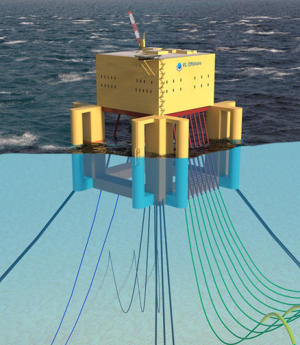

















© Copyright to VL Offshore LLC








SES: Standardized Energy Substation
Floating HVDC Substation for Overcoming
Infrastructure Gaps
Large-Scale Floating Substation
The SES platform is a modular floating substation engineered to bridge the gap between deep-water wind potential and high-capacity (1.0+ GW) power grids, unlocking large-scale HVDC deployment in deep-water regions globally.The Challenge: Overcoming Scale &
Infrastructure
Traditional hull designs for high-capacity HVDC topsides are too massive for the vast majority of global shipyards. Current deployment is stalled by: • Infrastructure Gaps: Conventional hulls exceed the dry-dock and fabrication capacities of local markets (e.g., the US West Coast). • Prohibitive Costs: Port upgrades required to handle massive monolithic hulls are capital- intensive and delay project timelines. • Deep-Water Logistics: A lack of proven, scalable solutions for ultra-deep water environments and long-distance transmission.Key Innovations & Strategic
Advantages
The SES platform utilizes a Modular Assembly philosophy to bypass traditional maritime constraints: • Standardized Primary Hull: A universal primary hull (columns and pontoons) provides a consistent foundation, ensuring repeatable engineering for any site worldwide. • Tunable Offset Columns: Outboard columns provide superior stability and can be "tuned" to meet site-specific hydrodynamic and environmental demands. • Low-Cost Float-Over Integration: Designed for float-over topside integration, eliminating the need for high cost and rare heavy-lift crane vessels. • Optimized for Local Content: Engineered for standard fabrication yards. By utilizing square primary columns instead of cylindrical ones, the design eliminates the need for specialized, large- scale plate rolling machinery. • Port-Ready Draft: A shallow lightship draft allows for quayside topside integration and easy tow-out even in ports with strict depth restrictions.Design Variations
The SES1400 (1400 MW, HVDC) concept is validated for the world’s most demanding offshore basins: California (Ultra-deep water, 800+ m depth) and North Sea (Harshest seas).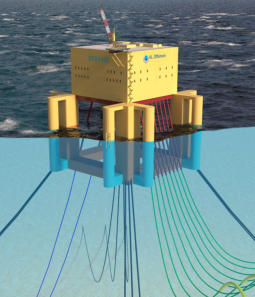












VL Offshore
VL Offshore